Update Your Information
Glossary
Organic is a label that indicates that a food or agricultural product has been produced according to the USDA organic standards, which require operations to use practices that cycle resources, conserve biodiversity, and preserve ecological balance. Organic farms and businesses are certified and inspected by USDA accredited certifiers.
Local farmers markets funded and operated by private groups or local governments.
A company that packages and labels products for its clients. In some cases, a co-packer may also handle services like cooking, processing, and blending ingredients before labeling and packaging.
Home-based, home-made food products prepared in a non-commercial kitchen and sold to the public.
Method of sale involving farmers, manufacturers, processors, or specialty food producers selling their food products wholesale to restaurant without the use of a food distributor.
SC Farm to School is a collaborative program between SC state agencies that seeks to cultivate relationships among South Carolina schools, farmers, and communities to increase the availability of healthy local food for schools, promote agriculture and nutrition education, and to provide experiential learning opportunities for students.
A kitchen designed and intended for use by the residents of a home but that is also used by a resident to produce cottage food products.
A method of sale where a product is sold directly to consumers on the farm from which it was produced.
Any marine organism that has been physically altered since capture, including seafood that has been filleted, gutted, packaged, canned, frozen, smoked, salted, cooked, pickled, dried, or prepared for market in any other manner.
Registration is required by the SC Food and Cosmetic Act for persons or firms wishing to manufacture, prepare, repack, or sell foods wholesale to other businesses. A Registration Verification Certificate (RVC) must be obtained from SCDA prior to selling food products wholesale (see definition below).
Selling directly to the end consumer (i.e., farmers markets and other direct-to-consumer markets). The producer or maker is present for the sale of products to the consumer.
Stores, markets, or stands which primarily sell local agricultural products and commodities to the public. A portion of the products offered for sale must include those grown or produced in South Carolina.
The SC Department of Agriculture owns and manages three regional state farmers markets in West Columbia, Florence, and Greenville which provide consumers with a wide variety of locally grown produce and specialty products.
Time/Temperature Control Sensitive—TCS foods require time and temperature controls to limit the growth of illness-causing bacteria.
A direct method of sale where customers visit the farm to harvest fruits, vegetables, flowers, or trees on their own.
Any produce that is processed further (washed, bagged, etc.) than the harvesting cut.
Selling produce or products to other businesses, e.g., roadside markets, restaurants, food service distributors, grocery or convenience-type stores, and other stores (including consignment). The producer or maker is not present for the final sale exchange to the consumer and relies on other parties to display, initiate sales, and receive payment.
Resources
Clemson Department of Plant Industries (DPI)
Clemson University Food2Market
SCDA Wholesale Food Safety
SCDA Retail Food Safety
SCDA Feed Safety
SC Meat-Poultry Inspection Department
SC Agritourism Association
SC Specialty Crop Association
SC Specialty Food Association
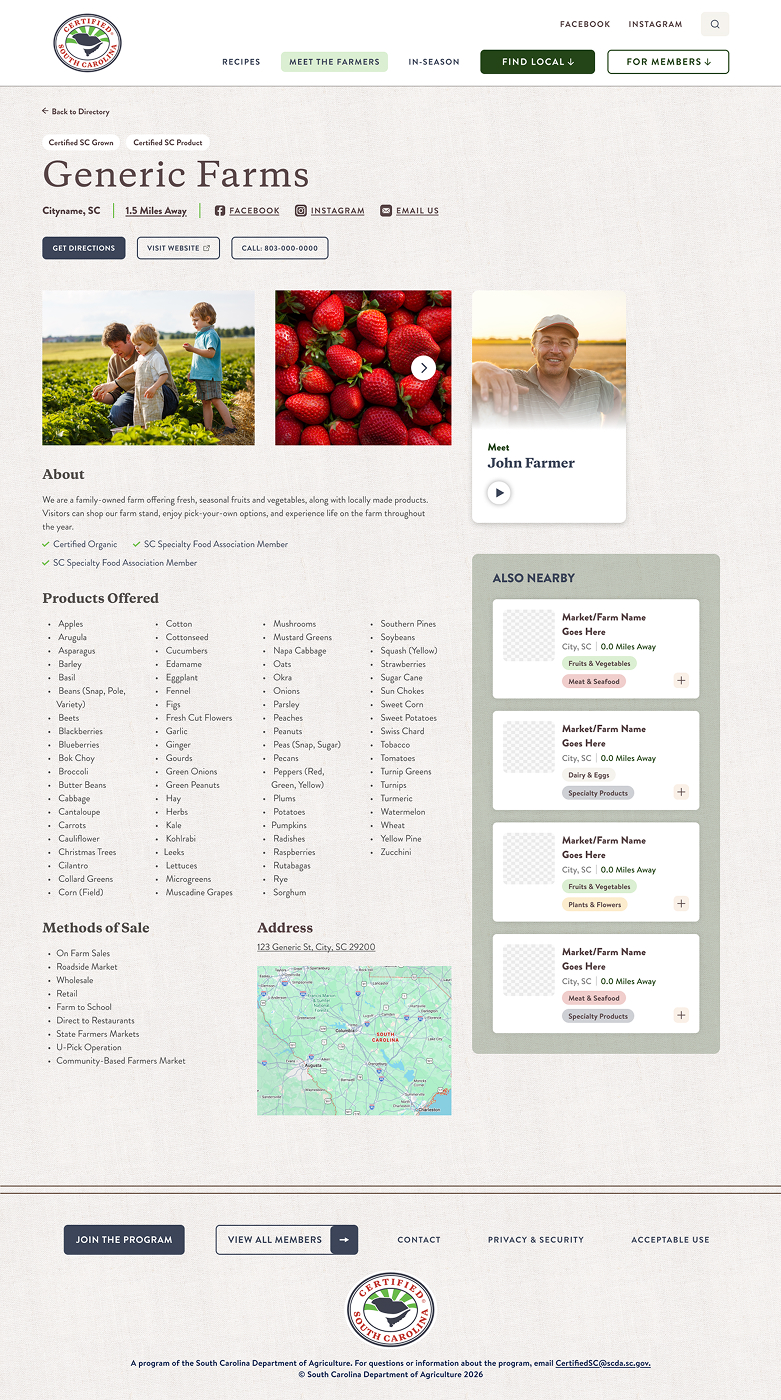
Your farm or business profile could look like this!
Resources
SC Department of Natural Resources
SCDA Wholesale Food Safety
Your farm or business profile could look like this!
"*" indicates required fields
Resources
SCDA Wholesale Food Safety
SCDA Retail Food Safety
Your farm or business profile could look like this!